Schools, faith and tolerance
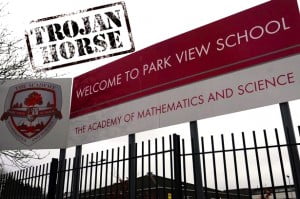 The case of the supposed 'Trojan Horse' infiltration of some Birmingham schools past 'Islamic fundamentalists' has, of class, generated more estrus than light. And information technology was only a thing of time earlier the spotlight was turned on Christian 'fundamentalist' schools. On Newsnight last night (starting at 26:xx into the programme), Jeremy Paxman introduced the upshot by asking: 'Where does belief cease and bigotry begin?'
The report looked at the use of the Accelerated Christian Education syllabus, which I retrieve could be fairly described equally American fundamentalist material that includes all sorts of odd elements which accept been well criticised. The study offered two interesting perspectives, one from a former pupil (with the slightly unlikely proper name of Jonny Scaramanga) who was quite disquisitional of the curriculum, and afterward from two current students at Maranatha Christian School who were quite impressive in their articulation of the need for and presence of disquisitional reflective thinking at the school.
Only the whole report opened up a large number of issues which take not really been thought through by many parties to this discussion. The head teacher of the school, Paul Medlock, posed a rather pointed question in the direction of Government policy on pedagogy: if choice is the issue, and then surely we tin cull what we believe? I think this highlights the lack of coherence of the current approach in encouraging 'free schools'—unless, of course, such a policy is driven by a quite different ideological or political calendar.
Some of the best points were fabricated past Michael Reiss, Professor of Science Education at the University of London, and an ordained Anglican. (The above-mentioned Jonny Scaramanga is actually one of Reiss' doctoral enquiry students—which gives some insight into how journalists find their sources!) He noted that, even if you cull to disbelieve (for example) the theory of evolution, and then y'all at least need to know that information technology is nigh universally supported past the scientific community—and the ACE curriculum needs to acknowledge this.
 Paxman then interviewed John Lewis, director of Christian Education Europe, who promote the ACE curriculum and its end-signal laurels, the International Certificate of Christian Didactics (ICCE), and Alice Roberts, well-known goggle box presenter, andProfessor of Public Date in Scientific discipline at theAcademy of Birmingham. Information technology was no surprise that Paxman made mince-meat of Lewis, who was baffled when Paxman suggested that at that place might be a difference between physical (scientific) questions, and metaphysical ones (why are we here?), and could give no really coherent explanation of the arguments against development, or say how erstwhile he thought the earth was. You would accept thought that a public spokesman on this issue might have mastered such basics.
But more surprising (to the critical eye) was Alice Roberts relatively poor performance too. Paxman bowled her a marvellous opening googley, which put her off her guard:
'Simply because we all believe the same affair doesn't mean that it is true, does it?'
She compared the theory of evolution with measuring the roundness of the earth, without acknowledging that the old has an historical, unrepeatable chemical element to it, whereas the latter is more like other, repeatable, testable scientific experiments—and it is this divergence which underlies the historically contested nature of the theory of evolution. She so challenged the ACE curriculum on the basis of 'standards' in education—though the previous report had noted that Maranatha Christian School has been assessed equally 'good' by OFSTED, in both teaching and curriculum. Moreover, the ICCE award has been validated past Britain NARIC (which assesses non-standard awards) as equivalent to GCSE and A-levels—which explains why pupils from the school regularly go on to attend top universities. (Some might think this shows what is wrong with the education organisation—just these are the standards Roberts was referring to.)
This debate highlights the lack of clear thinking in both ends of the discussion. The outset is the question of 'religion'. Regime policy and public debate talk almost 'organized religion' schools and 'faith' groups as if all 'faiths' were equal, and equally compatible with 'British' values (whatever they might be). Merely a moment's thought shows the problem with this. One of the issues in Birmingham was the declared gender segregation of pupils. Would information technology be acceptable for a Hindu faith school to teach the 'truth' of the degree system? Or for a Scientology school (recently classified as a 'religious faith') to teach about the visit of Thetans from outer infinite to Globe? Clearly non. Christian faith (and, arguably, Judaism) have a unique relationship with British 'values', culture and philosophical outlook because of the historical legacy of Christianity in the cultural and intellectual life of this land in particular and Western thought in full general.
Clear thinking here will only come when nosotros finish talking about 'faiths' in full general and start talking about the different faiths under consideration. What, for case, constitutes an extremist view? Is the idea that God raised Jesus from the expressionless, and that he is 'the manner, the truth and the life' extremist? If not, why non?
Just the second, equally important, question is 'What do we mean by "science"?' What are its methods, its claims, and its limitations? There is quite a strong intellectual tradition in British scientific and philosophical thinking which has argued that scientific thinking is essentially inimical to religious faith—a tradition represented by the empiricism (or 'logical atomism') of Bertrand Russell and the logical positivism of A J Ayer. (Both were the subject area of animated discussion when I was an undergraduate—though things might take moved on since and so.) Although Richard Dawkins' recent statements on not pedagogy children fairy stories seem like a parody to many, there is a sense that he is continuing this sceptical tradition—which tin can look very much like scientific 'fundamentalism.' And the one thing that did not come out in the Newsnight give-and-take is that Alice Roberts, similar Bertrand Russell, is an atheist with strong connections with the British Humanist Association, who have inappreciably been a dispassionate contributor to this discussion.
In the end, the question of organized religion schools and education does come up down to questions almost how nosotros know things. Nosotros therefore need to be request nearly which faith, which science, and which kind of cognition belong together in the educational context.
If yous enjoyed this, practise share it on social media (Facebook or Twitter) using the buttons on the left. Follow me on Twitter @psephizo. Like my page on Facebook.
Much of my work is done on a freelance basis. If you take valued this post, you can brand a single or echo donation through PayPal:
Comments policy: Skilful comments that engage with the content of the mail service, and share in respectful debate, can add real value. Seek first to understand, then to be understood. Make the most charitable construal of the views of others and seek to larn from their perspectives. Don't view argue as a conflict to win; accost the statement rather than tackling the person.
Source: https://www.psephizo.com/life-ministry/schools-faith-and-tolerance/

Postar um comentário for "Schools, faith and tolerance"