Barbara Bush a Born Again Christian
| Helena | |||||||||
|---|---|---|---|---|---|---|---|---|---|
| Augusta | |||||||||
 Seated statue of Helena in Musei Capitolini, Rome | |||||||||
| Roman empress | |||||||||
| Born | c. 246/48 AD | ||||||||
| Died | c. 330 AD Rome, Tuscania et Umbria | ||||||||
| Burial | Mausoleum of Helena | ||||||||
| Spouse | Constantius Chlorus | ||||||||
| Issue | Constantine I | ||||||||
| |||||||||
| Dynasty | Constantinian | ||||||||
| Faith | Nicene Christianity | ||||||||
Helena, Helena Augusta, or Saint Helena (; Greek: Ἑλένη , Helénē; c. 246/248 AD – c. 330) was an Empress of the Roman Empire and mother of Roman emperor Constantine the Bang-up. She was built-in in the lower classes[1] traditionally in the Greek urban center of Drepana, Bithynia, in Asia Minor, which was renamed Helenopolis in her honor, though several locations accept been proposed for her birthplace and origin.

A fresco from Trier, Deutschland, possibly depicting Helena, c. 310
Helena ranks equally an of import figure in the history of Christianity. In her final years, she made a religious bout of Syria Palaestina and Jerusalem, during which ancient tradition claims that she discovered the Truthful Cantankerous. The Eastern Orthodox Church, Catholic Church, Oriental Orthodox Churches, and Anglican Communion revere her every bit a saint, and the Lutheran Church building commemorates her.
Early life [edit]
Helena was a Greek;[2] [iii] [4] however, her birthplace is not known with certainty. The name Helena appears in all areas of the Empire. Joseph Vogt suggested that the name Helena was typical for the Greek-speaking part of the Roman Empire and that therefore her place of origin should be looked for in the eastern provinces of the Roman Empire.[5] The sixth-century historian Procopius is the earliest authority for the statement that Helena was a native of Drepanum, in the province of Bithynia in Asia Small. Yet, the name Helena wasn't epigraphically attested in inscriptions of Bithynia (Helena's proposed region of origin) and it was also mutual in Latin-speaking areas. Procopius lived much afterwards than the era he was describing and his description may have been actually intended as an etymological explanation most the toponym Helenopolis.[5] On the other hand, her son Constantine renamed the metropolis "Helenopolis" afterwards her death around 330 Advert, which supports the belief that the city was indeed her birthplace.[vi] The Byzantinist Cyril Mango has, still, argued that Helenopolis was refounded to strengthen the communication network effectually Constantine's new upper-case letter in Constantinople, and was renamed simply to laurels Helena, non to necessarily marking her birthplace.[seven] There was also a Helenopolis in Palestine[eight] and a Helenopolis in Lydia.[9] These cities, and the province of Helenopontus in the Pontus, were probably all named afterwards Constantine'due south mother.[vi] Two other locations in France and the Pyrenees have been named after Helena.[5] Equally uncertain to Drepanum and without strong documentation suggestions about her birthplace are: Naissus (cardinal Balkans), Caphar or Edessa (Messopotamia), Trier.[five]
The bishop and historian Eusebius of Caesarea states that Helena was about 80 on her return from Palestine.[10] Since that journey has been dated to 326–28, she was probably born around 246 to 249.[eleven] [12] Information nigh her social groundwork universally suggests that she came from the lower classes. Fourth-century sources, following Eutropius' Breviarium, record that she came from a apprehensive groundwork. Bishop Ambrose of Milan, writing in the tardily 4th century was the starting time to call her a stabularia, a term translated as "stable-maid" or "inn-keeper". He makes this annotate a virtue, calling Helena a bona stabularia, a "expert stable-maid".[13] Other sources, especially those written afterward Constantine'southward declaration as emperor, gloss over or ignore her groundwork.[eleven]
Both Geoffrey of Monmouth and Henry of Huntingdon promoted a popular tradition that Helena was a British princess and the girl of "Former King Cole" from the area of Colchester. This led to the later dedication of 135 churches in England to her, many in around the surface area of Yorkshire,[14] and revived every bit a suggestion in the 20th century in the novel by Evelyn Waugh.
Spousal relationship to Emperor Constantius [edit]
Information technology is unknown where she first met Constantius.[fifteen] The historian Timothy Barnes has suggested that Constantius, while serving under Emperor Aurelian, could have met her while stationed in Asia Minor for the campaign against Zenobia. It is said that upon meeting they were wearing identical silvery bracelets; Constantius saw her as his soulmate sent by God. Barnes calls attending to an epitaph at Nicomedia of i of Aurelian's protectors, which could indicate the emperor'south presence in the Bithynian region soon after 270 Advertizement.[16] The precise legal nature of the relationship between Helena and Constantius is too unknown. The sources are equivocal on the betoken, sometimes calling Helena Constantius' "wife", and sometimes, following the dismissive propaganda of Constantine'south rival Maxentius,[17] calling her his "concubine".[fifteen] Jerome, mayhap confused by the vague terminology of his ain sources, manages to practice both.[18]
Some scholars, such as the historian Jan Drijvers, assert that Constantius and Helena were joined in a common-police marriage, a cohabitation recognized in fact but not in law.[19] Others, like Timothy Barnes, assert that Constantius and Helena were joined in an official marriage, on the grounds that the sources claiming an official marriage are more than reliable.[20]
Helena gave nascency to the future emperor Constantine I on 27 February of an uncertain yr before long later 270[21] (probably effectually 272).[22] At the fourth dimension, she was in Naissus (Niš, Serbia).[23] In social club to obtain a wife more than consonant with his rise status, Constantius divorced Helena some time before 289, when he married Theodora, Maximian's girl under his command.[24] (The narrative sources date the marriage to 293, but the Latin panegyric of 289 refers to the couple every bit already married).[25] Helena and her son were dispatched to the court of Diocletian at Nicomedia, where Constantine grew to be a member of the inner circle. Helena never remarried and lived for a fourth dimension in obscurity, though close to her but son, who had a deep regard and affection for her.
Later Constantine'southward rising to the throne [edit]
Constantine was proclaimed Augustus of the Roman Empire in 306 by Constantius' troops subsequently the latter had died, and post-obit his elevation his mother was brought back to the public life in 312, returning to the imperial court. She appears in the Eagle Cameo portraying Constantine'southward family unit, probably commemorating the birth of Constantine'due south son Constantine Ii in the summer of 316.[a] She received the title of Augusta in 325. According to Eusebius, her conversion to Christianity followed her son becoming emperor.
Pilgrimage and relic discoveries [edit]

The church of the Archangel Michael founded by St. Helen in Sille, Konya in Asia Minor in 327

Helena finding the True Cross, Italian manuscript, c. 825

Constantine appointed his mother Helena as Augusta Imperatrix, and gave her unlimited admission to the imperial treasury in lodge to locate the relics of the Christian tradition. In 326–28 Ad Helena undertook a trip to Palestine.[26] According to Eusebius of Caesarea (260/265 – 339/340), who records the details of her pilgrimage to Palestine and other eastern provinces, she was responsible for the construction or adornment of two churches, the Church of the Nascence, Bethlehem, and the Church of Eleona on the Mount of Olives, sites of Christ's nascency and rising, respectively. Local founding fable attributes to Helena's orders the structure of a church in Egypt to identify the Burning Bush of Sinai. The chapel at Saint Catherine's Monastery—often referred to as the Chapel of Saint Helen—is dated to the year 330.
The True Cantankerous and the Church of the Holy Sepulchre [edit]
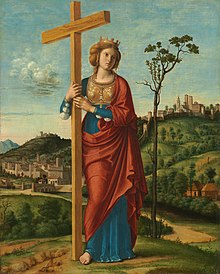

Jerusalem was all the same existence rebuilt post-obit the devastation caused by Titus in 70 Advertisement. Emperor Hadrian had built during the 130s a temple to Venus over the supposed site of Jesus' tomb near Calvary, and renamed the metropolis Aelia Capitolina. Accounts differ concerning whether the temple was defended to Venus or Jupiter.[27] Co-ordinate to Eusebius, "[t]here was a temple of Venus on the spot. This the queen (Helena) had destroyed."[28] According to tradition, Helena ordered the temple torn downward and, according to the legend that arose at the end of the 4th century, chose a site to begin excavating, which led to the recovery of three dissimilar crosses. The legend is recounted in Ambrose, On the Death of Theodosius (died 395) and at length in Rufinus' capacity appended to his translation into Latin of Eusebius's Ecclesiastical History, the primary body of which does not mention the event.[b] Then, Rufinus relates, the empress refused to be swayed by anything short of solid proof and performed a test. Possibly through Bishop Macarius of Jerusalem, she had a woman who was almost expiry brought from the city. When the woman touched the first and second crosses, her status did not change, but when she touched the tertiary and final cantankerous she of a sudden recovered,[c] and Helena declared the cross with which the woman had been touched to be the True Cross.
On the site of discovery, Constantine ordered the building of the Church of the Holy Sepulchre. Churches were also built on other sites detected by Helena.
The "Letter From Constantine to Macarius of Jerusalem", every bit presented in Eusebius' Life of Constantine, states:
- "Such is our Saviour's grace, that no power of language seems adequate to depict the wondrous circumstance to which I am well-nigh to refer. For, that the monument of his [Christ'southward] most holy Passion, so long ago buried beneath the ground, should have remained unknown for so long a series of years, until its reappearance to his servants at present set gratuitous through the removal of him who was the common enemy of all, is a fact which truly surpasses all admiration. I have no greater care than how I may all-time adorn with a fantabulous structure that sacred spot, which, under Divine direction, I take disencumbered as it were of the heavy weight of foul idol worship [the Roman temple]; a spot which has been deemed holy from the starting time in God'southward judgment, but which now appears holier still, since it has brought to light a clear assurance of our Saviour's passion."[29]
Sozomen and Theodoret claim that Helena too found the nails of the crucifixion. To use their miraculous power to aid her son, Helena allegedly had one placed in Constantine's helmet, and some other in the bridle of his equus caballus. According to one tradition, Helena acquired the Holy Tunic on her trip to Jerusalem and sent it to Trier.
Republic of cyprus [edit]
Several relics purportedly discovered past Helena are now in Cyprus, where she spent some time. Amid them are items believed to be part of Jesus Christ'south tunic, pieces of the holy cross, and pieces of the rope with which Jesus was tied on the Cross. The rope, considered to exist the only relic of its kind, has been held at the Stavrovouni Monastery, which was also said to have been founded by Helena. According to tradition, Helena is responsible for the large population of cats in Cyprus. Local tradition holds that she imported hundreds of cats from Egypt or Palestine in the fourth century to rid a monastery of snakes. The monastery is today known equally "St. Nicholas of the Cats" (Greek Άγιος Νικόλαος των Γατών ) and is located near Limassol.[30]
Rome [edit]
Helena left Jerusalem and the eastern provinces in 327 to return to Rome, bringing with her large parts of the True Cross and other relics, which were then stored in her palace's private chapel, where they can be still seen today. Her palace was after converted into the Basilica of the Holy Cross in Jerusalem. This has been maintained by Cistercian monks in the monastery which has been attached to the church for centuries.
Death and burial [edit]
Helena died effectually 330, with her son at her side. She was cached in the Mausoleum of Helena, outside Rome on the Via Labicana. Her sarcophagus is on display in the Pio-Clementine Vatican Museum, although the connection is often questioned. Next to her is the sarcophagus of her granddaughter Constantina (Saint Constance).
Sainthood [edit]
| Saint Helena of Constantinople | |
|---|---|
 Statue of Saint Helena in St. Peter'south Basilica, Rome, Italia | |
| Empress, Female parent of Saint Constantine, Equal to the Apostles, Protector of the Holy Places | |
| Venerated in |
|
| Canonized | Pre-Congregation[d] |
| Major shrine | The shrine to Saint Helena in St. Peter's Basilica |
| Feast |
|
| Attributes | Crown Cross Nails |
| Patronage | archaeologists, converts, difficult marriages, divorced people, empresses, Saint Helena island, new discoveries, Noveleta, Cavite |

Helena is considered by the Eastern Orthodox, Oriental Orthodox, Eastern and Roman Catholic churches, as well as by the Anglican Communion and Lutheran Churches, equally a saint. She is sometimes known as Helen of Constantinople to distinguish her from others with similar names, and is "Ilona" in Hungarian, and "Liena" in Republic of malta.[ citation needed ]
Her banquet day as a saint of the Eastern Orthodox Church is celebrated with her son on 21 May, the "Feast of the Holy Cracking Sovereigns Constantine and Helena, Equal to the Apostles".[31] Her banquet day in the Roman Catholic Church building falls on 18 August. Her feast day in the Coptic Orthodox Church is on nine Pashons. Anglican churches, and some Lutheran churches, continue the 21 May date.
Her discovery of the Cross along with Constantine is dramatised in the Santacruzan, a ritual pageant in the Philippines.[ citation needed ] Held in May (when Roodmas was one time celebrated), the procession likewise bears elements of the month's Marian devotions. Helena is the patron saint of new discoveries.[ citation needed ]
In the Ethiopian and Eritrean Orthodox Tewahedo Churches, the feast of Meskel, which commemorates her discovery of the cantankerous, is historic on 17 Meskerem in the Ethiopian agenda (September 27, Gregorian agenda, or on 28 September in leap years). The holiday is usually celebrated with the lighting of a large blaze, or Demera, based on the belief that she had a revelation in a dream. She was told that she should make a bonfire and that the fume would testify her where the true cantankerous was cached. So she ordered the people of Jerusalem to bring wood and brand a huge pile. After adding frankincense to it the bonfire was lit and the fume rose high up to the sky and returned to the basis, exactly to the spot where the Cross had been buried.[32]
Helena is remembered in the Church of England with a celebration on 21 May.[33]

Baroque statue of "Santa Liena" in the 2011 hamlet festa procession of Birkirkara, Malta
Relics [edit]
Her alleged skull is displayed in the Cathedral of Trier, in Germany.[ citation needed ] Portions of her relics are found at the basilica of Santa Maria in Ara Coeli in Rome, the Église Saint-Leu-Saint-Gilles in Paris, and at the Abbaye Saint-Pierre d'Hautvillers.
The church of Sant'Elena in Venice claims to have the complete body of the saint enshrined under the chief altar. In 1517, the English priest, Richard Torkington, having seen the relics during a visit to Venice described them as follows: " She lith in a ffayr place of faith, of white monks, ye may see her confront perfythly, her trunk ys covered with a cloth of whith sylke ... Too at that place lyes upon her breast a lytell crosse made of the holy crosse ... "[34] In an ecumenical gesture, these relics visited the Orthodox Church building of Greece and were displayed in the church of Agia Varvara (Saint Barbara) in Athens from 14 May to 15 June 2017.[35]
Later cultural traditions [edit]
In British folklore [edit]
In Great Britain, later on legend, mentioned by Henry of Huntingdon but made popular past Geoffrey of Monmouth, claimed that Helena was a daughter of the Male monarch of Britain, Cole of Colchester, who allied with Constantius to avoid more war between the Britons and Rome.[due east] Geoffrey further states that she was brought upwardly in the manner of a queen, as she had no brothers to inherit the throne of Britain. The source for this may have been Sozomen'due south Historia Ecclesiastica, which, however, does not claim Helena was British merely only that her son Constantine picked up his Christianity there.[36] Constantine was with his begetter when he died in York, but neither had spent much fourth dimension in U.k..
The statement made past English chroniclers of the Eye Ages, according to which Helena was supposed to have been the daughter of a British prince, is entirely without historical foundation. Information technology may ascend from the similarly named Welsh princess Saint Elen (alleged to take married Magnus Maximus and to accept borne a son named Constantine) or from the misinterpretation of a term used in the fourth chapter of the panegyric on Constantine's union with Fausta. The clarification of Constantine honoring Uk oriendo (lit. "from the outset", "from the beginning") may accept been taken as an allusion to his birth ("from his offset") although it was actually discussing the start of his reign.[37]
At least xx-five holy wells currently be in the United Kingdom dedicated to a Saint Helen. She is also the patron saint of Abingdon and Colchester. St Helen'southward Chapel in Colchester was believed to accept been founded by Helena herself, and since the 15th century, the town'south coat of arms has shown a representation of the True Cantankerous and three crowned nails in her accolade.[38] Colchester Boondocks Hall has a Victorian statue of the saint on top of its 50-metre-high (160 ft) tower.[39] The arms of Nottingham are almost identical because of the city's connectedness with Cole, her supposed father.[xl]
Filipino legend and tradition [edit]
Flores de Mayo honors her and her son Constantine for finding the Truthful Cross with a parade with floral and fluvial themed parade showcasing her, Constantine and other people who followed her journey to observe the True Cantankerous. Filipinos named the parade sagala.[ citation needed ]
Medieval legend and fiction [edit]
In medieval legend and chivalric romance, Helena appears as a persecuted heroine, in the vein of such women equally Emaré and Constance; separated from her husband, she lives a serenity life, supporting herself on her embroidery, until such time every bit her son's amuse and grace wins her husband'south attention and then the revelation of their identities.[41]
Modern fiction [edit]
Helena is the protagonist of Evelyn Waugh's 1950 novel Helena. She is too the main character of Priestess of Avalon (2000), a fantasy novel by Marion Zimmer Bradley and Diana L. Paxson. She is given the name Eilan and depicted as a trained priestess of Avalon.
Helena is likewise the protagonist of Louis de Wohl's novel The Living Wood (1947) in which she is once more the daughter of Male monarch Coel of Colchester. In the 2021 novel Eagle Ascending past Dan Whitfield she is depicted equally having lived to age 118 as result of the powers of the True Cross.[42]
Notes [edit]
- ^ The cameo was incorporated in the rich binding of the Ada Gospels; the year 316 is argued in Stephenson 2010:126f.
- ^ Noted in Stephenson 2010:253f, who observes "None of this is true", noting Rufinus' source in a lost piece of work of Gelasius of Caesarea.
- ^ In that location are actually several different accounts: Catholic Encyclopedia: Archaeology of the Cantankerous and Crucifix: "Following an inspiration from on loftier, Macarius caused the three crosses to be carried, one after the other, to the bedside of a worthy adult female who was at the point of death. The touch of the other two was of no avail; just on touching that upon which Christ had died the woman got suddenly well once more. From a letter of St. Paulinus to Severus inserted in the Breviary of Paris it would appear that St. Helena herself had sought by means of a phenomenon to discover which was the True Cross and that she caused a human being already dead and buried to be carried to the spot, whereupon, by contact with the tertiary cross, he came to life.
From the 1955 Roman Cosmic Marian Missal: St. Helen, the offset Christian Empress, went to Jerusalem to effort to detect the True Cross. She establish it in 320 Advertisement on 14 September. In the 8th century, the feast of the Finding was transferred to 3 May and on 14 September was celebrated the "Exaltation of the Cross," the commemoration of a victory over the Persians past Heraclius, as a issue of which the relic was returned to Jerusalem.
From however another tradition, related by St. Ambrose following Rufinus, information technology would seem that the titulus, or inscription, had remained fastened to the Cross."; see likewise Socrates' Church building History at CCEL.org: Book I, Chapter XVII: The Emperor's Female parent Helena having come to Jerusalem, searches for and finds the Cross of Christ, and builds a Church. - ^ Her canonization pre-dates the practice of formal canonization by vatican city and by the relevant Orthodox Churches."Baronial 18 in German History". TGermanCulture.com.ua. Retrieved 16 October 2016.
Her designation as a saint precedes the practise of canonization past the Pope.
- ^ The purely legendary British connectedness is traced by A. Harbus, Helen of Britain in Medieval Legend, 2002.
References [edit]
Citations [edit]
- ^ Anonymus Valesianus ane.2, "Origo Constantini Imperatoris".
- ^ Phelan, Marilyn E.; Phelan, Jay M. (viii June 2021). In His Footsteps: The Early Followers of Jesus. Wipf and Stock Publishers. p. 67. ISBN978-one-6667-0186-9.
- ^ Stanton, Andrea L. (2012). Cultural Sociology of the Centre Eastward, Asia, and Africa: An Encyclopedia. SAGE. p. 25. ISBN978-1-4129-8176-7.
- ^ Vatikiotis, Michael (5 August 2021). Lives Between The Lines: A Journeying in Search of the Lost Levant. Orion. p. 138. ISBN978-1-4746-1322-4.
- ^ a b c d Drijvers 1992, p. 12
- ^ a b Harbus, 12.
- ^ Mango, 143–58, cited in Harbus, xiii.
- ^ Günter Stemberger, Jews and Christians in the Holy Land: Palestine in the fourth century, 2000, p. ix (full text).
- ^ Hunt, 49, cited in Harbus, 12.
- ^ Eusebius, Vita Constantini three.46.
- ^ a b Harbus, 13.
- ^ Drijvers 1992, p. 15.
- ^ Ambrose, De obitu Theodosii 42; Harbus, 13.
- ^ John Munns, Cross and Culture in Anglo-Norman England: Theology, Imagery, Devotion, p245
- ^ a b Lieu and Montserrat, 49.
- ^ Inscriptiones Latinae Selectae 2776, cited in Barnes, "New Empire," 36.
- ^ Paul Stephenson, Constantine, Roman Emperor, Christian Victor, 2010:126f.:130.
- ^ Hieronymus, Chronica, south.a. 292, p. 226, 4 and s.a. 306, p. 228, 23/four, cited in Lieu and Montserrat, 49.
- ^ Drijvers, Helena Augusta, 17–19.
- ^ Barnes, New Empire, 36.
- ^ Barnes, CE, 3, 39–42; Elliott, Christianity of Constantine, 17; Odahl, fifteen; Pohlsander, "Constantine I"; Southern, 169, 341.
- ^ Barnes, CE, 3; Barnes, New Empire, 39–42; Elliott, "Constantine'due south Conversion," 425–6; Elliott, "Eusebian Frauds," 163; Elliott, Christianity of Constantine, 17; Jones, 13–fourteen; Lenski, "Reign of Constantine" (CC), 59; Odahl, 16; Pohlsander, Emperor Constantine, 14; Rodgers, 238; Wright, 495, 507.
- ^ Barnes, CE, 3.
- ^ Barnes, CE, 8–9.
- ^ Origo 1; Victor, Caes. 39.24f; Eutropius, Brev. 9.22.1; Epitome 39.2; Pan. Lat. 10(ii).11.four, cited in Barnes, CE, 288 n.55.
- ^ Norwich, John Julius (1996). Byzantium (Showtime American ed.). New York. pp. 68–69. ISBN0394537785. OCLC 18164817.
- ^ Stephenson 2010:252.
- ^ Eusebius, Church building History, Life of Constantine, Oration in Praise of Constantine. From Philip Schaff, Nicene and Mail-Nicene Fathers[one]
- ^ Eusebius, Church History, Life of Constantine, Oration in Praise of Constantine. From Philip Schaff, Nicene and Post-Nicene Fathers [2]
- ^ Dubin, Marc (2009). The Rough Guide To Republic of cyprus . Rough Guide. pp. 135–136. ISBN9781858289939.
- ^ "May 21: Banquet of the Holy Swell Sovereigns Constantine and Helen, Equal to the Apostles". Greek Orthodox Archdiocese of America. Archived from the original on 7 November 2007. Retrieved 28 March 2008.
- ^ "Walta Data Centre". Meskel Being Celebrated Beyond The Nation. Archived from the original on 19 March 2006. Retrieved 14 September 2005.
- ^ "The Agenda". The Church building of England . Retrieved 27 March 2021.
- ^ "Fourth dimension Nowadays and Time Past: Aboriginal Skulls and Medieval Skullduggery - the Mysterious Afterlives of Saint Helena". nine August 2015.
- ^ "The Holy Relics of Saint Helen came to Greece for the first fourth dimension since 1211". 15 May 2017.
- ^ "Socrates and Sozomenus Ecclesiastical Histories". Christian Classics Ethereal Library. Archived from the original on xviii May 2008. Retrieved 28 March 2008.
- ^ "Catholic Encyclopedia: St. Helena".
- ^ "Colchester In The Early Fifteenth Century". Dur.air conditioning.uk. Archived from the original on 29 December 2008. Retrieved 26 March 2013.
- ^ "Colchester Boondocks Hall:: Os grid TL9925 :: Geograph Britain and Ireland – photograph every grid foursquare!". Geograph.org.uk . Retrieved 26 March 2013.
- ^ "Nottinghamshire history > Articles > Articles form the Transactions of the Thoroton Society > An itinerary of Nottingham: St Mary's churchyard". Nottshistory.org.uk. i June 2010. Retrieved 26 March 2013.
- ^ Laura A. Hibbard, Medieval Romance in England p. 29 New York: Burt Franklin, 1963
- ^ Whitfield, Dan (2021). Eagle Ascending. U.s.: Touch on Indicate Press. ISBN978-1-952816-51-2.
Sources [edit]
- Barnes, Timothy D. Constantine and Eusebius (CE in citations). Cambridge, Massachusetts: Harvard University Printing, 1981. ISBN 978-0-674-16531-i
- Barnes, Timothy D. The New Empire of Diocletian and Constantine (NE in citations). Cambridge, Massachusetts: Harvard Academy Press, 1982. ISBN 0-7837-2221-4
- Drijvers, January Willem (1992). Helena Augusta. BRILL. ISBN978-xc-04-09435-ii.
- Drijvers, Jan Willem. "Evelyn Waugh, Helena and the True Cross." Classics Ireland 7 (2000).
- Elliott, T. G. "Constantine's Conversion: Exercise We Really Need It?" Phoenix 41 (1987): 420–438.
- Elliott, T. G. "Eusebian Frauds in the "Vita Constantini"." Phoenix 45 (1991): 162–171.
- Elliott, T. Thou. The Christianity of Constantine the Slap-up . Scranton, PA: Academy of Scranton Printing, 1996. ISBN 0-940866-59-5
- Harbus, Antonia. Helena of Britain in Medieval Legend. Rochester, NY: D.S. Brewer, 2002.
- Jones, A.H.M. Constantine and the Conversion of Europe. Buffalo: Academy of Toronto Printing, 1978 [1948].
- Hunt, E.D. Holy Land Pilgrimage in the Later Roman Empire: A.D. 312–460. Oxford: Clarendon Press, 1982.
- Lenski, Noel. "The Reign of Constantine." In The Cambridge Companion to the Age of Constantine, edited by Noel Lenski, 59–90. New York: Cambridge University Press, 2006. Hardcover ISBN 0-521-81838-ix Paperback ISBN 0-521-52157-two
- Lieu, Samuel N. C. and Dominic Montserrat. From Constantine to Julian: Pagan and Byzantine Views. New York: Routledge, 1996.
- Mango, Cyril. "The Empress Helena, Helenopolis, Pylae." Travaux et Mémoires 12 (1994): 143–58.
- Odahl, Charles Matson. Constantine and the Christian Empire. New York: Routledge, 2004.
- Pohlsander, Hans. The Emperor Constantine. London & New York: Routledge, 2004. Hardcover ISBN 0-415-31937-4 Paperback ISBN 0-415-31938-2
- Rodgers, Barbara Saylor. "The Metamorphosis of Constantine." The Classical Quarterly 39 (1989): 233–246.
- Wright, David H. "The Truthful Face of Constantine the Smashing." Dumbarton Oaks Papers 41 (1987): 493–507
Farther reading [edit]
- Bietenholz, Peter Thousand. (1994). Historia and fabula: myths and legends in historical thought from antiquity to the modern age. Leiden: Brill. ISBNxc-04-10063-6.
- Burckhardt, Jacob (1949). The Age of Constantine the Great. Moses Hadas, trans. New York: Pantheon Books.
- Grant, Michael (1994). Constantine the Great: the human being and his times . New York: Scribner. ISBN0-684-19520-viii.
- Pohlsander, Hans A. (1995). Helena: empress and saint. Chicago: Ares Publishers. ISBN0-89005-562-9.
External links [edit]
- St. Helena at Catholic Online
- Kirsch, Johann Peter (1913). . Catholic Encyclopedia.
- Delehaye, Hippolyte (1911). . Encyclopædia Britannica (11th ed.).
- De Imperatoribus Romanis: Helena Augustus (248/249–328/329 AD)
- Eternal Word Goggle box Network: Saint Helena Widow c. 330
- The Self-Ruled Antiochian Orthodox Christian Archdiocese of Northward America: St. Helen, Mother of Emperor Constantine, Equal of the Apostles
- s9.com: Helena
- Sts. Constantine & Helen Greek Orthodox Church: The Lives of Sts. Constantine & Helen
- A Treasury of Martyrs and Saints: Saint Helen, and Emperor Constantine the Great
- Saint Eleanor Catholic Church (Ruidoso, NM) & Saint Jude Cosmic Mission (San Patricio, NM): St Helena
- Holy Monastery of St. Catherine at Mountain Sinai: Saint Helen and the Holy Monastery of Sinai
- Saint Helena at the Christian Iconography web site
- Of the Invention of the Holy Cross from Caxton's translation of the Gilt Legend
Source: https://en.wikipedia.org/wiki/Helena,_mother_of_Constantine_I

Postar um comentário for "Barbara Bush a Born Again Christian"